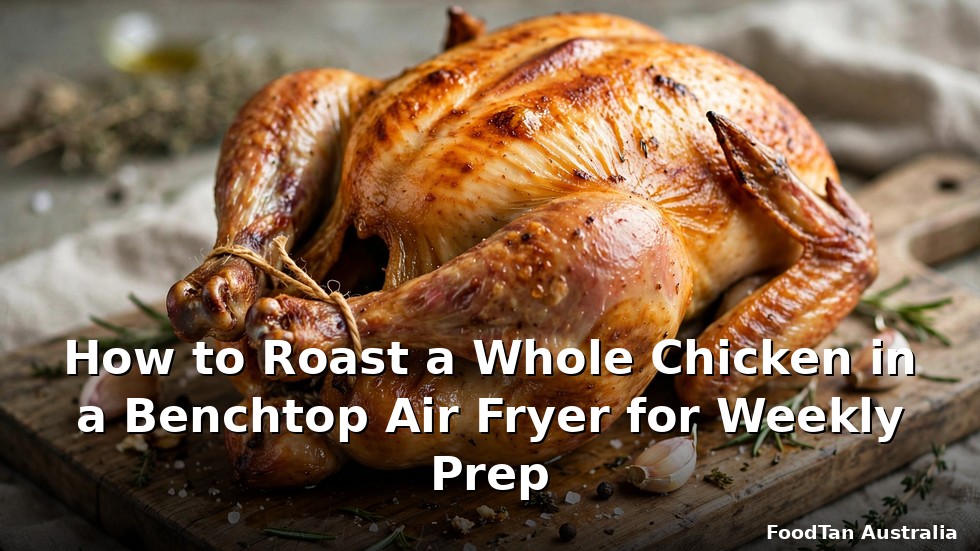
How to Roast a Whole Chicken in a Benchtop Air Fryer for Weekly Prep
- A 1.4–1.8kg chicken fits most 5L+ benchtop air fryers and roasts in 55–65 minutes at 180°C.
- Brine or dry-salt the bird the night before for noticeably juicier meat.
- Start breast-side down, flip halfway — this protects the breast from drying out.
- One bird yields 4–6 meal-prep serves plus a carcass for free stock (estimates).
- Total cost per serve lands around $2.50–$3.50 including roast veg (estimates).
A whole roast chicken is the undisputed king of budget protein in Australia. One bird, bought on special for $8–$12, turns into days of meals — and the carcass makes stock that would cost $4 at the supermarket. Roasting it in a benchtop air fryer instead of the oven makes it faster, cheaper to run, and — thanks to the fierce circulating heat — gives you shatteringly crisp skin. This is the complete guide to air fryer whole chicken meal prep in Australia, from choosing the bird to stretching it across the week.
Will a Whole Chicken Fit Your Air Fryer?
This is the first question, and the honest answer is: it depends on your model. A 1.4–1.6kg chicken fits comfortably in most 5–8 litre basket air fryers and in virtually all oven-style air fryers. Compact 3–4 litre models will struggle — you’d need a small 1.1–1.2kg bird, and even then it’s tight.
Measure before you shop: you want at least 3–4cm clearance between the top of the chicken and the heating element. If the skin touches the element, it burns. When in doubt, buy the smaller bird — a 1.4kg chicken still feeds a prepper for days.
- 5L+ basket air fryer: 1.4–1.8kg bird fits well.
- Oven-style air fryer: up to 2kg on the middle rack.
- 3–4L compact fryer: 1.1–1.2kg bird max, or spatchcock a larger one (see below).
The spatchcock shortcut
If your bird is too big, spatchcock it: cut out the backbone with kitchen shears, press flat, and it cooks faster and more evenly while fitting awkward spaces. A spatchcocked 1.6kg chicken roasts in about 45–50 minutes at 180°C. The backbone goes straight into the stock pot — nothing wasted.
Buying the Bird: Best Value in Australia
Whole chickens are one of the cheapest proteins per kilo in the country. Typical prices (estimates — specials change weekly):
- Home-brand whole chicken: $5–$7/kg at Coles and Woolworths. A 1.6kg bird: roughly $8–$11.
- Branded (Ingham’s, Lilydale): $7–$10/kg. Nicer, but the home-brand bird roasts just as well with proper seasoning.
- Aldi: Often the cheapest per kilo when in stock — check the weekly catalogue.
- Free-range: $10–$14/kg. A treat, not a prep staple, unless it’s marked down.
The real bargains are the markdowns. Supermarkets routinely discount whole chickens approaching their use-by date by 30–50%. Buy two, roast one tonight, freeze one. Also check the “roast-ready” seasoned birds — sometimes they’re cheaper than plain, though the seasoning is usually just salt and paprika you could add yourself for cents.
Prep: The Night-Before Difference
You can season and roast immediately with good results. But if you have 12–24 hours, a dry brine transforms the bird: salt draws moisture out, then the salty moisture gets reabsorbed, seasoning the meat deeply and helping the skin dry out for maximum crispness.
- Remove the chicken from its packaging. Pull out the neck and any giblets from the cavity (save the neck for stock).
- Pat completely dry inside and out with paper towel.
- Salt generously: about 1 tablespoon of sea salt flakes all over, including inside the cavity.
- Refrigerate uncovered on a plate for 12–24 hours. The uncovered rest dries the skin — this is the crisp-skin secret.
- Before cooking, rub with 1 tablespoon of oil and your spice mix. Try: 2 tsp smoked paprika, 1 tsp garlic powder, 1 tsp dried thyme, 1 tsp cracked pepper.
- Optional: stuff the cavity with half a lemon and a few thyme sprigs for aroma.
No time for the overnight rest? Even 1–2 hours of uncovered salting in the fridge helps. And if you’re cooking straight from the shop, just salt, oil, spice, and go — it’ll still beat a store-bought roast chook.
The Roast: Step by Step
- Preheat the air fryer to 180°C for 3–5 minutes.
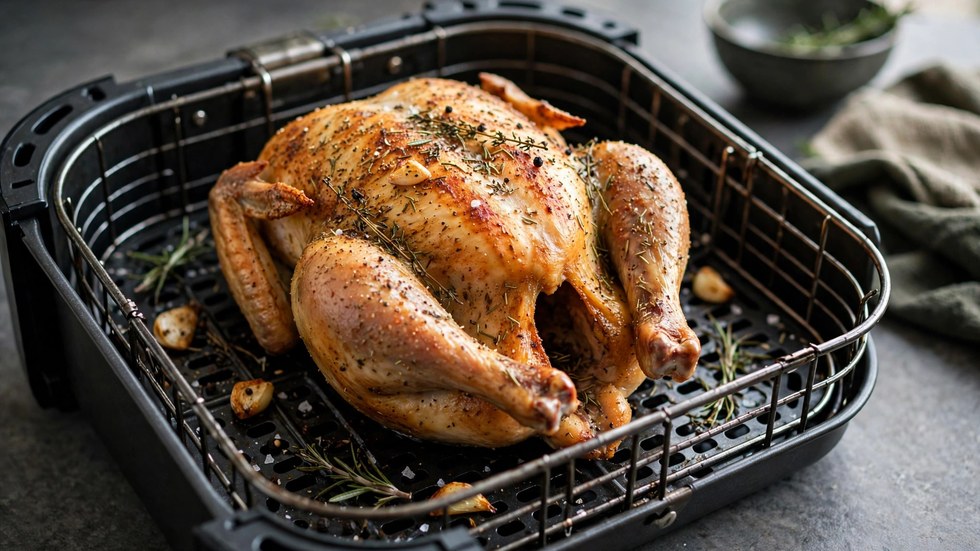
- Place the chicken breast-side DOWN in the basket. This is the key technique: the breast (the leanest, driest part) sits in the rendering juices and is shielded from the direct heat of the element.
- Cook for 30 minutes at 180°C.
- Flip carefully — breast-side up now — using tongs and a spatula. The skin will have started to colour.
- Cook for a further 25–35 minutes until deeply golden and the juices run clear. Total time: 55–65 minutes for a 1.4–1.6kg bird.
- Check doneness: a thermometer in the thickest part of the thigh (not touching bone) should read 75°C. No thermometer? Pierce the thigh — juices must run completely clear, not pink.
- Rest for 15 minutes on a board, tented loosely with foil. Non-negotiable — resting keeps the juices in the meat instead of on the board.
Air Fryer Whole Chicken Meal Prep Australia: Timing Chart
| Bird weight | Temp | Total time | Notes |
|---|---|---|---|
| 1.1–1.3kg (small) | 180°C | 45–55 min | Flip at 25 min |
| 1.4–1.6kg (medium) | 180°C | 55–65 min | The standard prep bird; flip at 30 min |
| 1.7–2.0kg (large) | 180°C | 65–75 min | Only for 6L+ or oven-style fryers |
| Spatchcocked 1.6kg | 180°C | 45–50 min | Skin-side up the whole time; no flip needed |
| Chicken pieces (1kg) | 190°C | 30–35 min | Turn once; great when whole birds are pricey |
As always, treat times as starting points — verify with a thermometer or the clear-juices test, and note what works in your specific model.
Breaking Down the Bird for the Week
A 1.6kg raw chicken yields roughly 900g–1kg of cooked meat once bones and shrinkage are accounted for. Here’s a realistic weekly plan:
- Night one: Classic roast dinner — a breast and leg with air fryer roast pumpkin, carrots, and peas. The immediate reward for your effort.
- Lunches (2–3 days): Shredded breast meat in containers with rice or roast veg. About 150g meat per container.
- Wraps or sandwiches: Sliced thigh meat (more flavour, stays moist) with salad in wraps for grab-and-go lunches.
- Fried rice or pasta: Dice the pickings from the carcass — the bits you strip after the main carving — into fried rice or a quick pasta.
- The carcass: Into a pot with water, an onion, carrot, and celery. Simmer 2–3 hours for 1–1.5 litres of stock worth ~$4 at the shop. Freeze in portions.
Realistically, one medium bird covers 4–6 serves of meat plus stock. For a solo prepper, that’s most of a week’s protein from a single $10 bird.
Cost Breakdown: The Full Picture
| Item | Quantity | Est. cost (AUD) |
|---|---|---|
| Whole chicken (home brand) | 1.6kg @ ~$6/kg | $9.60 |
| Salt, oil, spices, lemon | Pantry + ½ lemon | $0.60 |
| Electricity (air fryer, ~65 min) | ~1.5 kWh | $0.48 |
| Roast veg for 4 serves | Pumpkin, carrot, potato | $3.00 |
| Total / per serve (4 serves) | ~$13.68 / ~$3.42 |
Australian Meal Prep & Macro Estimator
Pop in your costs in $ AUD and get per-portion cost, macros and storage guidance.
Under three-fifty a serve for a proper roast dinner with veg (estimates) — and that ignores the stock, which is effectively a free bonus worth several dollars. A store-bought hot chook alone costs $11–$13 and gives you no stock and no veg. Plug your local chicken price into the calculator to compare.
Storage, Safety & the Stock Pot
Strip the meat from the carcass within 2 hours of cooking — don’t leave the bird sitting on the bench all evening. Refrigerate shredded meat in airtight containers at or below 4°C and use within 3–4 days. The stock should be cooled quickly (an ice bath in the sink speeds this up) and refrigerated within 2 hours; it keeps 3–4 days refrigerated or 3 months frozen.
Reheat shredded chicken until steaming hot (75°C). A splash of stock in the container before microwaving keeps it moist — which is a good reason to make the stock in the first place.
Making the most of the carcass
Don’t skip the stock. It’s the highest-value 10 minutes of active work in this whole recipe: carcass in a pot, cover with cold water, add a quartered onion, a chopped carrot, a celery stick, and a bay leaf. Bring to a gentle simmer (never a rolling boil — that makes it cloudy), skim any foam, and simmer 2–3 hours. Strain, cool fast, and portion into containers. You’ve just made something the supermarket charges $3–$4 a litre for, from literal scraps.
You May Also Like
Reheating Prepped Meals in the Air Fryer Without Soggy Bases
Air Fryer Pork Chops with Crackling Side for Work Lunches