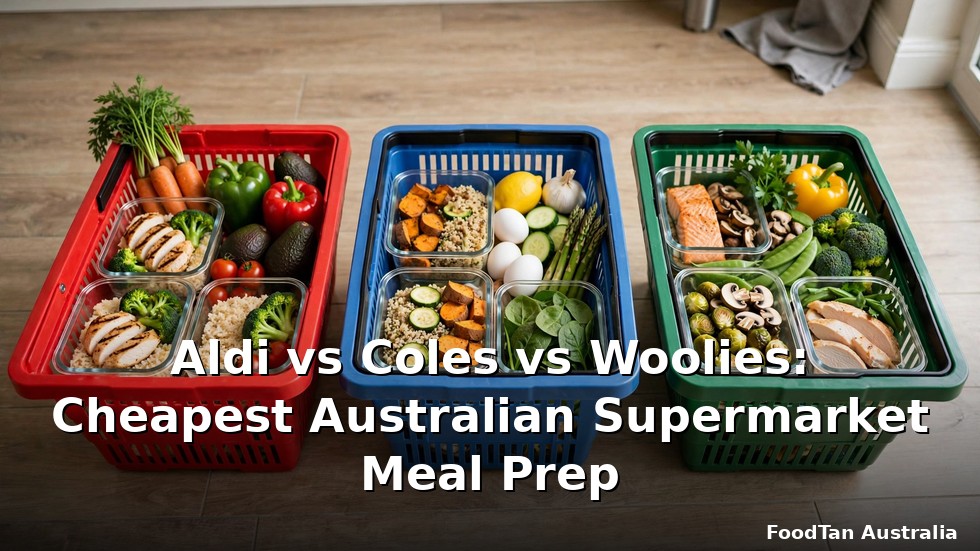
Aldi vs Coles vs Woolies: Cheapest Australian Supermarket Meal Prep
Ask any Australian meal prepper where they shop and you’ll start a barney. The Aldi faithful swear the big two are a rort. The Coles and Woolies loyalists point at flybuys points, delivery, and the fact that Aldi doesn’t sell half the things they need. Everyone’s working from vibes and one memorable receipt. So let’s do it properly: a fixed 20-item meal prep basket, priced across Aldi Australia, Coles and Woolworths, with honest notes on where each store wins and where it quietly loses. All prices below are estimates based on typical shelf prices at the time of writing — they move with specials, seasons and states, so treat this as a framework, not a price guarantee. If you want the cheapest Australian supermarket meal prep strategy — not just the cheapest shelf prices — read on. This is independent editorial; FoodTan is not affiliated with or endorsed by any of these retailers.
Key Takeaways
- Aldi Australia usually wins a like-for-like meal prep basket on price, often by 10–20%.
- Coles and Woolworths win on range, half-price specials cycles, loyalty programs and online shopping.
- The cheapest strategy is a hybrid: Aldi for staples, Coles or Woolies for specials and fresh meat.
- Per-kilo and per-100g unit pricing is the only fair way to compare across the three stores.
How This Comparison Works
The basket is 20 items a real meal prepper buys weekly: proteins (chicken breast, chicken mince, eggs, tinned tuna, Greek yoghurt, tasty cheese), carbs (rice, pasta, oats, wraps), veg (frozen mixed veg, fresh broccoli, carrots, onions, potatoes), and flavour (tinned tomatoes, olive oil, soy sauce, taco seasoning). Where pack sizes differ between stores — and they will — everything is compared on unit price: dollars per kilo or per 100 grams. That’s the only number that matters, and it’s printed on every shelf ticket in Australia. Learn to read it and no supermarket can fool you again.
One more ground rule: we’re comparing each store’s cheapest equivalent option — home brand against home brand, since that’s how budget shoppers actually buy. Comparing Aldi’s home-brand cheddar to Woolworths’ branded specialty cheese would be a stitch-up.
The 20-Item Basket: Head-to-Head Estimates
| Item | Aldi (est.) | Coles (est.) | Woolworths (est.) | Cheapest |
|---|---|---|---|---|
| Chicken breast 1kg | $11.00 | $13.00 | $13.00 | Aldi |
| Chicken mince 500g | $5.50 | $6.50 | $6.50 | Aldi |
| Eggs, 12-pack | $4.20 | $5.00 | $5.00 | Aldi |
| Tinned tuna 4-pack | $4.50 | $5.50 | $5.50 | Aldi |
| Greek yoghurt 1kg | $4.80 | $5.50 | $5.50 | Aldi |
| Tasty cheese 500g | $6.00 | $7.00 | $7.00 | Aldi |
| Long-grain rice 2kg | $3.40 | $4.00 | $4.00 | Aldi |
| Pasta 500g | $0.95 | $1.15 | $1.15 | Aldi |
| Rolled oats 750g | $1.80 | $2.20 | $2.20 | Aldi |
| Wraps 8-pack | $2.00 | $2.50 | $2.50 | Aldi |
| Frozen mixed veg 1kg | $2.60 | $3.20 | $3.20 | Aldi |
| Broccoli (per head) | $1.80 | $2.20 | $2.20 | Aldi |
| Carrots 1kg | $1.20 | $1.50 | $1.50 | Aldi |
| Brown onions 1kg | $1.80 | $2.00 | $2.00 | Aldi |
| Potatoes 2kg | $3.00 | $4.00 | $4.00 | Aldi |
| Tinned tomatoes 400g × 4 | $2.80 | $3.60 | $3.60 | Aldi |
| Olive oil 500ml | $6.50 | $8.00 | $8.00 | Aldi |
| Soy sauce 500ml | $1.80 | $2.50 | $2.50 | Aldi |
| Taco seasoning | $0.90 | $1.20 | $1.20 | Aldi |
| Milk 2L | $3.10 | $3.30 | $3.30 | Aldi |
| Basket total | $70.95 | $83.85 | $83.85 | Aldi |
On everyday shelf price, Aldi takes the basket by roughly $13 — about 15% cheaper. That pattern holds across most categories: Aldi’s limited-range, high-volume model genuinely delivers lower everyday prices on staples. But — and it’s a substantial but — this table assumes full price at Coles and Woolies, and nobody who meal preps seriously pays full price at the big two.
Australian Meal Prep & Macro Estimator
Pop in your costs in $ AUD and get per-portion cost, macros and storage guidance.
Where the Big Two Fight Back: Specials Cycles
Coles and Woolworths run on a promotional rhythm Aldi simply doesn’t have. Half-price specials rotate weekly: one week it’s tinned tuna and pasta, the next it’s chicken and cheese. A shopper who plans their prep around the catalogue — buying the limit on half-price proteins and staples — can routinely beat Aldi’s everyday price on those lines. Half-price $13/kg chicken breast at $6.50/kg undercuts Aldi’s $11/kg by a mile.
The maths that matters isn’t “Aldi vs Coles on a random Tuesday.” It’s “Aldi everyday vs Coles/Woolies shopped strategically.” The strategic big-two shopper who buys proteins only on special, stocks the pantry on half-price weeks, and fills the gaps with home-brand staples will often match or beat the Aldi-only shopper — with a much wider range to choose from.
Range: Aldi’s Achilles Heel for Preppers
Here’s where the comparison gets honest about lifestyle, not just dollars. Aldi stocks around 1,500 lines; Coles and Woolworths stock 20,000+. For a meal prepper, that gap shows up in specific, annoying ways: no fresh herbs in most Aldi stores, limited spice range, no specialty diet lines, a fraction of the sauce and condiment selection, and the infamous Special Buys middle aisle that tempts you into buying a kayak instead of kale.
If your prep style is simple — chicken, rice, veg, repeat — Aldi covers you completely and you’ll save real money. If you cook across cuisines, need specific ingredients (miso, fish sauce varieties, fresh coriander by the bunch, low-carb wraps), or follow a particular eating pattern, you’ll end up doing a second shop at Coles or Woolies anyway. Two shops cost time and fuel, which are also money.
Fresh Produce: Closer Than You’d Think
Aldi’s fresh produce is genuinely competitive — often the cheapest per-kilo option for basics like carrots, onions and potatoes. But the range is narrow and quality can be patchy; anyone who’s bought Aldi avocados knows the gamble. Coles and Woolworths have broader produce sections, better “odd bunch” and marked-down ranges (a prepper’s goldmine — ugly veg cooks exactly the same), and more consistent quality on delicate items like berries and herbs.
The marked-down produce section at Coles and Woolies deserves special mention. End-of-day markdowns on veg that’s perfectly fine for a curry, soup or stir-fry can drop prices below Aldi levels. If your store run timing is flexible, the clearance rack is the single cheapest source of fresh produce in the country.
Meat: Quality, Range and the Freezer Strategy
Aldi meat is good value and the quality is generally solid — their chicken and mince hold up fine in blind tests. But the range is limited and pack sizes are fixed. Coles and Woolworths offer bigger value packs, more cuts, and crucially, regular half-price and “2 for $X” meat specials. The winning meat strategy is agnostic: buy whichever store has your protein on special that week, portion it, and freeze it. Loyalty to one store for meat is just paying extra for sentiment.
The Verdict: Cheapest Australian Supermarket Meal Prep by Shopper Type
Shop Aldi-first if…
You prep simple, repeatable meals; you value the lowest everyday shelf price without catalogue-watching; you live near a store; and you’re disciplined enough to walk past the Special Buys aisle.
Shop Coles/Woolies-first if…
You plan around weekly specials; you use flybuys or Everyday Rewards (the points and fuel discounts add up); you shop online; you need broad range, specialty ingredients or specific brands; or you hunt marked-down produce.
The hybrid play (the actual cheapest option)
Do your staple run at Aldi — rice, pasta, oats, tinned goods, frozen veg, eggs, cheese, yoghurt — then hit Coles or Woolworths for the week’s half-price proteins and anything Aldi doesn’t stock. Yes, it’s two stops. But for a serious prep week, the hybrid shop routinely beats any single-store strategy by $10–$20, and you get the best of both ranges. The cheapest Australian supermarket meal prep isn’t a store — it’s a system.
The Hidden Costs Nobody Puts in the Table
Shelf price isn’t the full price of a shop. The hybrid two-store strategy saves $10–$20 on the receipt but costs you a second trip — fuel, parking, and roughly 40 minutes of your weekend. For most metro shoppers with an Aldi near a Coles or Woolies (and in Australia’s suburbs, they usually are), that’s a minor cost. For regional shoppers driving 20 minutes each way, the maths flips: one efficient shop at whichever store is closest usually beats a cheaper basket eaten up by petrol.
Then there’s the impulse tax. Aldi’s Special Buys aisle is engineered to separate you from money you didn’t plan to spend — the $70 basket becomes $110 because the air fryer was “such good value.” Coles and Woolies have their own version: the front-of-store displays, the “down down” end caps, the bakery smell. The cheapest supermarket is the one where you buy the list and leave. Discipline beats store choice every single time.
Loyalty programs deserve honest accounting too. Flybuys and Everyday Rewards return roughly 0.5% in points on your spend, plus targeted offers and occasional bonus-point promotions that can be genuinely valuable — 10x points on a $150 shop is real money. Fuel discounts add a few cents per litre. None of this makes Coles or Woolworths cheaper than Aldi on shelf price, but for a $200-a-week family shop, the annual loyalty value can run into the hundreds. Factor it in; don’t let it decide for you.
You May Also Like
Everyday Rewards Flybuys Grocery Hacks: Cut Your Meal Prep Bill in Half
High Protein Meal Prep Woolworths: 5 Days Under $40 AUD